—

Gear editing, Oz rings, presets, and loadouts

Edit each equipment slot with the item drawer, set up Oz rings, tell presets apart from loadouts, and track spare copies.

Covers Gear Editor

The gear grid and the item drawer

Click any slot on the gear grid and an item drawer opens. Its tabs depend on the item: General, Star Force, Scrolling (not offered on Heroic), Flames, and Potential. The All button opens a step-by-step setup for the slot — one section at a time with Back and Next, entries saving as you type — so you can fill a piece in a single pass.
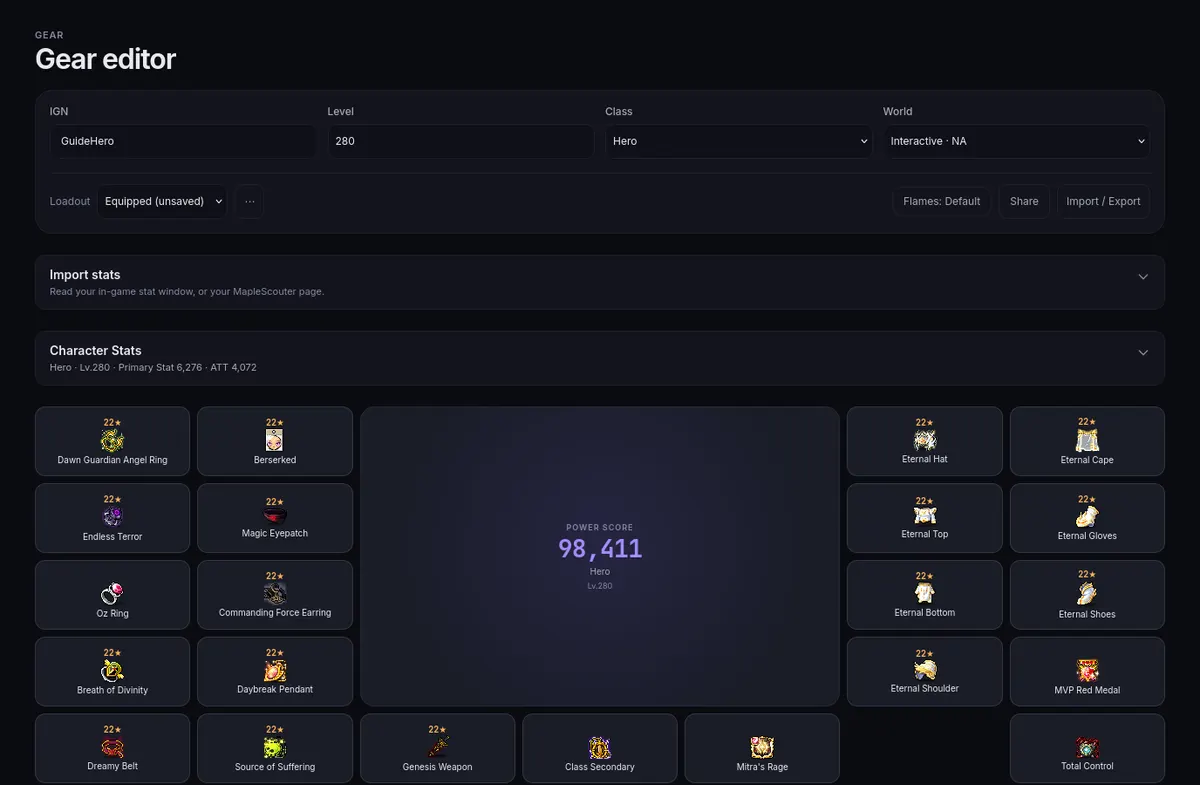
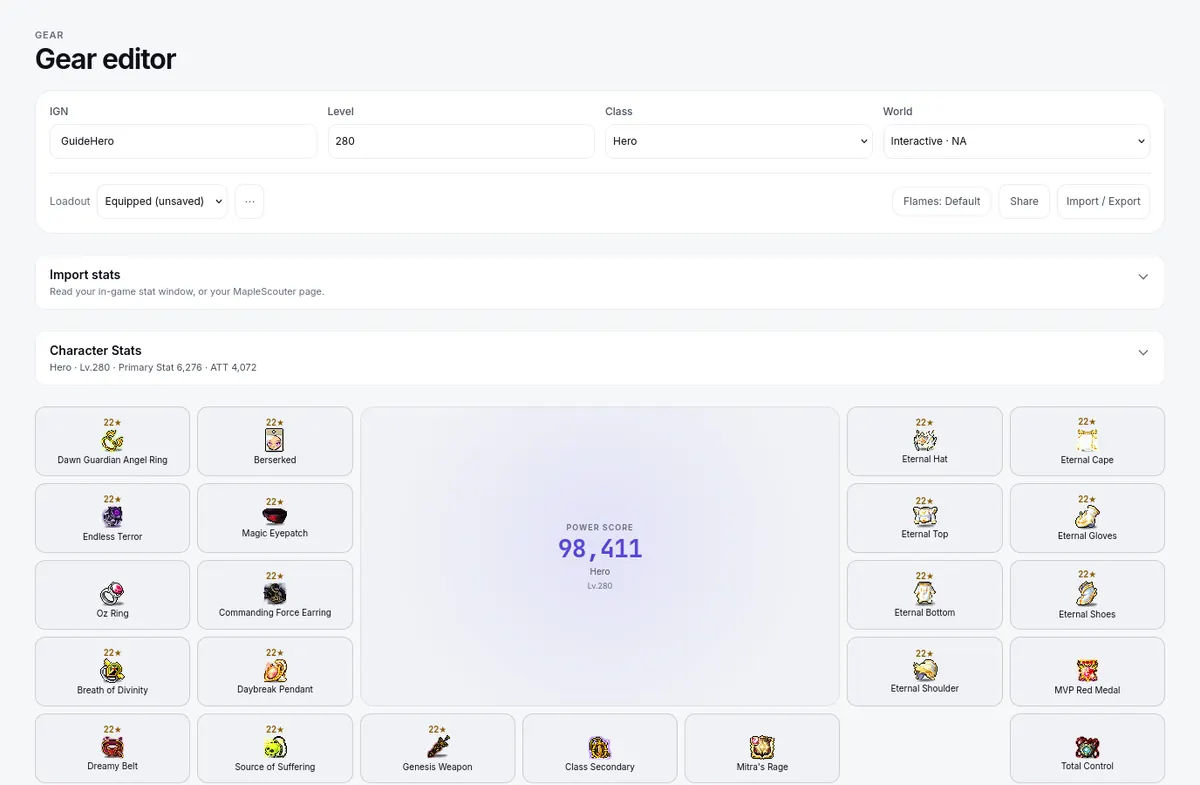
The gear editor's equipment grid: one tile per slot with its stars, around your power scoreThe gear editor's equipment grid: one tile per slot with its stars, around your power score

  1. General: pick the item from the Preset picker (search by name, set, or level) so the calculators know what you hold, or choose Custom and type its name and level.
  2. Enter the item's current actual state — stars, flame lines, scroll state, and potential lines, exactly as the item shows in game.
  3. On General, fill in Spare Items Owned and Replacement Cost (for boom) where the item uses them.

Review any values filled by the item preset against your actual item, then correct differences before comparing upgrades.

Oz rings, including the Continuous Ring rules

Open a ring slot on Gear and choose the Oz Ring preset (or tick Oz Ring (BiS, no upgrades) on General). The drawer then shows a panel labeled Oz Rings (Skill Rings), which states its own rule: Equip one ring at any level. Add a second ring with a Lv. 4+ Restraint or Continuous Ring.

  • The Active selector holds your active ring; the separate Continuous Ring selector holds your Continuous Ring. Both selectors stay visible.
  • Set each ring's Lv so the Lv. 4+ threshold and each ring's contribution are read correctly.
  • Toggle Burst or Overall to weigh the ring's Final Damage for a burst window or averaged over a fight.

If you select a combination the rule cannot support, the site unequips the incompatible ring and shows a notice — read it and adjust. Until you pick rings, a Finish your Oz Ring setup banner on the Dashboard points you back here.

Presets are starting templates

Character presets (on Onboarding and when you create a new character on Characters) describe typical gear for a class and progression point. They are not personal saved loadouts — anything you entered yourself is your build, and an applied preset simply becomes the starting point you edit from.

  1. If a preset roughly matches your character, apply it to skip most of the typing.
  2. Review every value it filled in: stars, flames, scrolls, and potential lines are yours alone and often differ.
  3. Correct what differs before you trust a score or recommendation.

The Preset picker inside an item drawer is different: it identifies one item and fills that item's fixed facts, so you never retype what the item already determines. Check what a preset changed before letting it replace gear you already entered, then save your corrected build under your loadout.

Loadouts and switching

The gear editor's header holds a Loadout selector. It stays disabled and reads Save character first until your character is saved. Loadouts let one character keep alternatives: different star targets, a flame variant, or a before/after copy. Separate characters belong on the roster in Characters & resources instead.

  • The editor always shows the equipped loadout, and edits on the page save to it.
  • Loadout actions live behind the ⋯ menu: Save as new…, Rename…, and Delete….
  • Save your work before switching, so nothing sits unsaved in an old loadout.
  • Check the active character and loadout name before editing or switching.

Star Force protection plans

Every Star Force row is priced with a protection plan, chosen at three levels.

  1. Account: in Settings under Star Force, pick Balanced (SG 1144), Always protect (SG 4444), Cheapest per star, or No protection (no SG 1111), or leave Site default. On Gear, the Star Force plan bar's Apply to all items menu sets one of those on every item of the character on screen, and Use default clears them.
  2. Item: open an item's Star Force tab. Star Force plan offers Use site default (or Use account setting) and Custom for this item, with presets, an Every other star strategy, and a choice for each protectable star step (Auto follows the strategy). The Dashboard's Star Force rows open the same choices from the protection chip on the row.
  3. One-off check: the Upgrade Calculator can try a plan and save it to the item.

An item's own plan wins over the account setting everywhere that prices it. In the shorthand, SG means Safeguard on 15→18★, and the four digits are the Enhancement Mode at 18→19★, 19→20★, 20→21★, and 21→22★ (1 = none, 4 = full protection). On Heroic the site default is Balanced, but Pitched and Brilliant items default to Always protect until you set a plan.

A Star Force cost includes climbing back after a boom, so one star can cost several times its own taps.

Spare copies and wildcard spares

Spare copies are entered per item in its drawer (Spare Items Owned on General), and broader spare currencies are tracked in the Spares tab of the income page. The Gear page keeps a Wildcard Spares summary with a Manage in Weekly resources link.

  1. On each spare item you actually hold, fill in its count in the item's own drawer. The Spares tab's Item spares list shows the same counts; an item that cannot use spares is marked Not used.
  2. Keep your Star Cores, Pitched Star Cores, Whisper Crystals, Dawn Whisper Crystals, Gollux Coins, and Trace Restore Points counts current on the income page.

Keep both current: recommendations about risky star attempts or buying a replacement read the spares on hand, and stale counts make those calls for you.

Flames: enter what you have

The Flames tab scores the flame lines your item has, so enter them as the in-game item shows them — line by line.

  1. Read each flame line off your item and record it in the drawer.
  2. Use the scoring it reports to compare which of your pieces would gain most from a reroll.

The score compares current states; it does not preview what a reroll would produce — random outcomes stay random. Numbers copied from roll tables or other tools do not belong here; the actual lines on your item are what the scoring reads.